

Difference between Youth and Adult Criminal Charges
When a person is accused of an offence in Canada, age can change the entire path of the case. A teenager facing an allegation is not treated the same way as an adult because Canadian law recognizes that young people are still developing, may respond better to guidance, and should have a fair chance to move forward without one mistake defining their future.
For families in Toronto, the process can feel overwhelming. Parents may worry about court, school, police contact, privacy, and whether a youth record will affect education or employment. Adults facing charges often have different concerns, including public court records, bail conditions, possible jail time, and long-term employment or travel barriers.
Kahlon Law assists clients with both youth and adult criminal matters across Toronto and the GTA. The goal is always practical: protect your rights, explain the process clearly as well as the difference between youth and adult criminal charges, and build a defence strategy that fits the facts, the person, and the possible consequences.
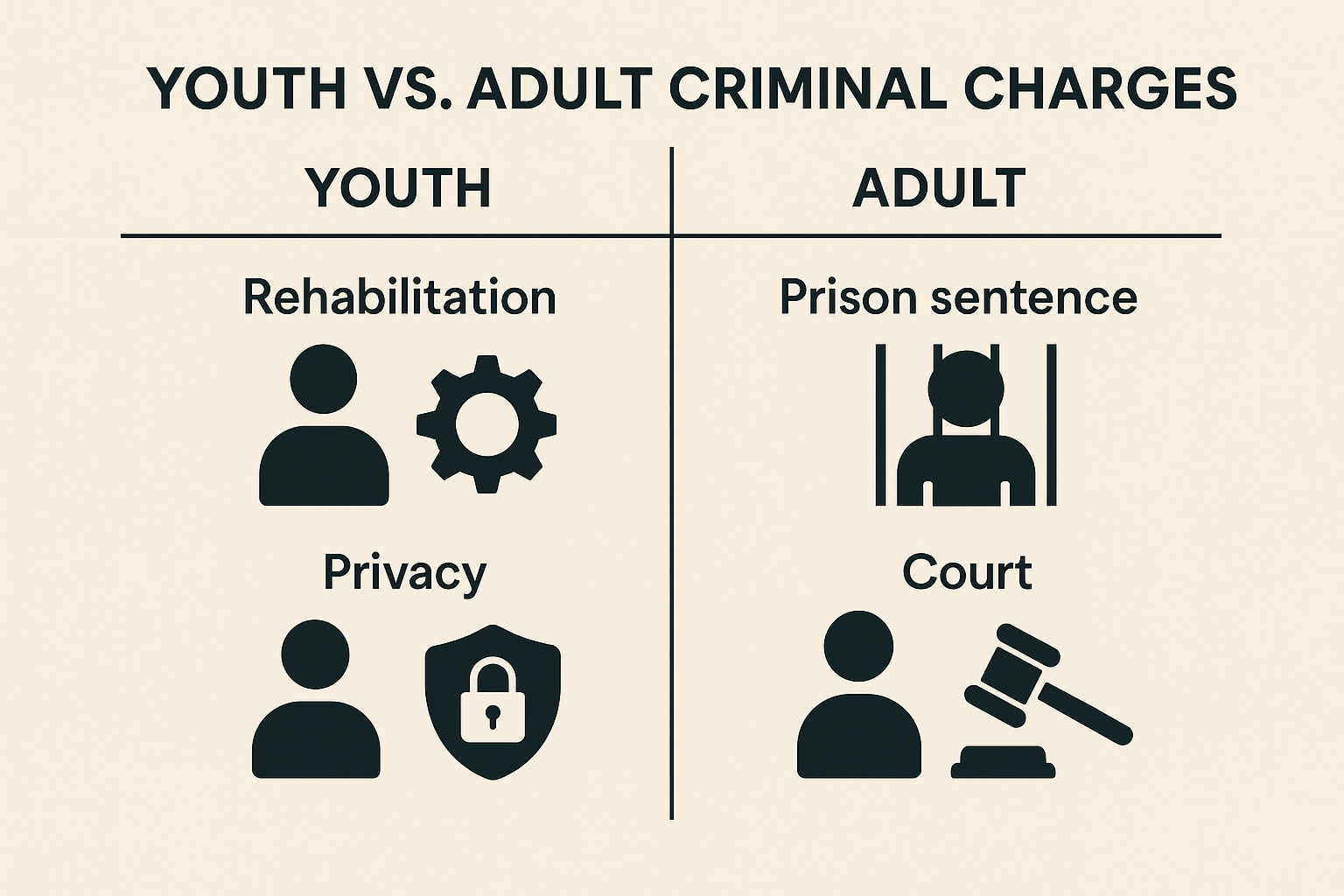
Legal Framework: How the YCJA Differ from Adult Criminal Proceedings
The main difference between youth and adult criminal charges starts with the law that applies. Adults are generally dealt with under the Criminal Code of Canada and related legislation. A young person between 12 and 17 is dealt with under the Youth Criminal Justice Act, often called the YCJA.
The YCJA was created for youth criminal matters because young people are not the same as adult offenders. They may be more affected by peer pressure, family circumstances, school problems, mental health concerns, trauma, or a limited understanding of consequences. The youth justice system considers those realities when decisions are made.
Adult criminal prosecution focuses heavily on responsibility, deterrence, public safety, and sentencing principles that apply to fully mature people. The youth system still requires accountability, but it places stronger weight on rehabilitation, reintegration, family involvement, and proportionate consequences.
That does not mean youth charges are minor. A youth can still face serious penalties, strict release conditions, probation, custody, and a lasting youth record for a period of time. In rare situations involving very serious offences, the Crown may seek an adult sentence. That possibility makes early legal advice very important.
Kahlon Law helps families understand what stream applies, what rights are available, and what steps can reduce harm while the case moves forward.
Youth Rights and Protections in the Justice System
Young people have protections that do not apply in the same way to adults. These protections are designed to reduce unnecessary harm, keep the process fair, and support rehabilitation where possible.
One major protection is privacy. Youth court is generally less public than adult court, and there are strict limits on publishing information that could identify a young person accused of an offence. Youth records are also handled differently from adult records. Access is limited, and records may be sealed or closed after set periods, depending on the outcome and later history.
Youth also have special rights when speaking with police. A young person must be told about their right to speak with a lawyer and, in many situations, a parent or another appropriate adult. If police take a statement, the rules are strict. If those rules are not followed, the statement may be challenged.
Legal representation matters because youth may not fully understand what is happening, what they are agreeing to, or how a decision today could affect them later. A defence lawyer can explain the allegation in age-appropriate language, review disclosure, identify weaknesses in the Crown’s case, and advocate for outcomes that protect the young person’s future.
Important protections for youth may include:
- privacy limits on names, records, and identifying details
- access to a lawyer before giving a statement
- procedures that account for age, maturity, and personal circumstances
- sentencing options focused on rehabilitation and reintegration
- opportunities for diversion, counselling, restorative measures, or community-based outcomes
- family and community involvement where appropriate
Adults also have strong legal rights, including the right to silence, the right to counsel, disclosure rights, and trial rights. The difference is that the adult system usually offers fewer built-in protections around privacy and long-term record impact.
Court Process: Youth Court, Adult Court, and What Families Should Expect
Youth court and adult court can look similar from the outside, but the purpose and process are different. A young person may attend a youth court hearing with a parent or guardian. The court may want information about school, home life, supports, prior history, and any steps taken since the allegation.
In adult court, the process usually centres more directly on the charge, the evidence, bail, plea discussions, trial scheduling, and sentencing risk. Personal background may still matter, but it may not shape the process as strongly as it does in youth court.
For both youth and adults, the early stages often include release conditions. These conditions can affect daily life. A person may be ordered not to contact someone, stay away from a location, live at a certain address, follow a curfew, or avoid weapons, alcohol, or drugs. For a youth, conditions may interfere with school, friendships, work, or family routines. For an adult, conditions may affect parenting, employment, housing, or travel.
A defence lawyer can review whether conditions are too broad, unrealistic, or unfair. In some cases, a lawyer can seek changes that allow the accused person to continue school, work, treatment, or family responsibilities while the case is ongoing.
The court process also involves disclosure. Disclosure is the evidence the Crown intends to rely on, such as police notes, witness statements, videos, photos, or forensic material. Kahlon Law reviews disclosure carefully to assess whether the Crown can prove the charge, and whether negotiation, withdrawal, diversion, resolution, or trial is the right path.
Sentencing, Rehabilitation, and Adult Sanctions
Sentencing is one of the clearest differences between the youth and adult system. Youth sentencing is meant to hold the young person accountable while still supporting rehabilitation. Adult sentencing can involve a heavier focus on denunciation, deterrence, and public protection.
| Issue | Youth Approach | Adult Approach |
|---|---|---|
| Main focus | Accountability, rehabilitation, reintegration, and maturity | Responsibility, deterrence, denunciation, and public safety |
| Privacy | Stronger limits on publication and record access | Court information is usually more public |
| Sentencing options | Reprimands, community service, probation, counselling, restorative options, custody in serious cases | Discharges, fines, probation, conditional sentences, jail, and other penalties |
| Record impact | Youth record access is limited and may close after set periods | Adult criminal record may create long-term employment, travel, and immigration issues |
| Support systems | Greater use of family, school, counselling, and community supports | Supports may be available, but are less central to the process |
Youth sentencing can include meaningful consequences without treating the young person as though they are fully mature. The court may consider whether the offence was impulsive, whether the youth has taken responsibility, whether they have family support, whether school has been affected, and whether counselling or programming would help.
Adults may face harsher penalties for similar conduct, especially where violence, weapons, breach allegations, prior convictions, or vulnerable complainants are involved. A conviction can affect professional licensing, employment screening, volunteer work, travel to the United States, immigration status, and family law issues.
That is why defence strategy must match the client’s stage of life. For youth, the strategy may focus on diversion, privacy, school stability, family support, and avoiding a youth record where possible. For adults, the strategy may focus on avoiding a conviction, reducing penalties, protecting employment, and limiting future barriers.
Records, Future Opportunities, and Long-Term Impact
A criminal record can affect a person long after court ends. For adults, a conviction may appear on background checks and create barriers to work, housing, travel, education, volunteering, and professional opportunities. Even where a person later seeks a record suspension, the process can take time and may not erase every practical effect.
Youth records are different, but they should not be ignored. A youth record may be accessed by certain people or agencies for a set period. The length of access depends on the offence, outcome, sentence, and whether the young person commits another offence. If a youth later receives an adult conviction while the youth record is still open, the consequences can become more serious.
Families often ask whether a youth charge will ruin a child’s future. The honest answer is that it depends on the facts, the charge, the outcome, and what steps are taken early. Many youth cases can be steered toward outcomes that reduce long-term damage, especially when the defence is proactive.
Helpful steps may include:
- getting legal advice before speaking further with police
- saving messages, photos, videos, or other evidence
- following release conditions carefully
- keeping school, work, or counselling records that show progress
- avoiding contact with complainants or witnesses unless a lawyer confirms it is allowed
- involving supportive adults who can help the youth stay on track
Kahlon Law works with clients to build a clear plan. That may include challenging the evidence, negotiating with the Crown, seeking diversion, preparing for trial, or presenting strong background information to support a better outcome.
When a Youth May Face Adult-Level Consequences
Most young people remain in the youth justice system. However, serious cases can raise the possibility of an adult sentence. This may arise in matters involving severe violence, serious harm, or other allegations where the Crown believes a youth sentence would not be enough.
An adult sentence is not automatic. The court must consider the law, the facts, the young person’s age and maturity, their role in the offence, their background, and whether a youth sentence can still hold them accountable. Defence counsel can respond with evidence and submissions showing why the youth should remain within the youth sentencing framework.
This stage requires careful preparation. The defence may need school records, counselling records, family background, mental health information, community support plans, and evidence of rehabilitation. The goal is to show the court that the young person can be held accountable without losing the protections and rehabilitative focus of the YCJA.
Adults, by contrast, do not have access to the same youth-based sentencing protections. A person charged as an adult must respond within the adult criminal system, where penalties may be higher and the public record impact may be stronger.
Whether the accused is a teenager or an adult, timing matters. Early legal advice can prevent avoidable mistakes, protect rights during police contact, and create a stronger path before the case moves too far.
Speak with Kahlon Law about Youth or Adult Charges
A criminal charge can create fear, stress, and uncertainty for the accused person and their family. The right defence strategy depends on age, facts, evidence, court location, prior history, personal circumstances, and the outcome being sought.
Kahlon Law provides defence representation for youth and adults in Toronto and the GTA. The firm’s approach is direct, practical, and focused on protecting the client’s future while responding firmly to the allegations.